Wednesday, July 13, 2016

The Mesocosms at IUI: Exotic vacation real estate for the travelling copepod

Remember all the zooplankton we collected in the Gulf of Eilat? For the past few days, they have been living in a different home: a tank at IUI filled circulating seawater. There are five experimental mesocosms inside this tank, where our brave copepods are swimming, eating, and (if all goes according to plan) pooping.


The copepods' new home/jail.


A mesocosm is an experimental system used to examine parts of the natural environment with more controlled conditions. In this experiment, zooplankton swim around inside of nylon bags through which dissolved oxygen can permeate. The bags' placement within the seawater tank also allows for regulation of temperature. By delineating ecological interactions and better representing realistic conditions, they function somewhat like very simple, very temporary terrariums. As a link between field sampling and more controlled laboratory experiments, these mesocosms can help better evaluate the relevance of prior data supporting the hypothesis.

We added phytoplankton feeding solutions to each bag, and mixed local dust into some of them as well. At the end of the experiment, we will flush/repatriate the zooplankton back into the sea, and collect all of the sediment left behind in the bags. Fecal pellets picked out of sediment samples from the different mesocosms will be analyzed for their carbon content, and we will see if there are differences between pellets from the "dusty" bags and those from the "control" bags.

Eyal provided the four wider mesocosms with cylindrical bags; we will also use these in a similar experiment in Haifa. A UCSC engineering student named Gilberto designed the taller mesocosm in the middle, which uses a conical bag and includes a removable sediment trap at the bottom. 


Gilberto's technical drawing of the taller mesocosm, and closeups of the finished product before use.
The plastic bottle functions as a sediment trap which can be opened and closed with a ball valve for easy retrieval. It is stabilized with a plexiglass holder.


Every day, I measure water quality parameters inside each bag, and take samples to monitor zooplankton concentrations. I also sample for nutrients and trace metals. We built some brick "towers" for easier access to the taller mesocosm in the middle of the tank; this way I remain (mostly) dry throughout the sampling process. It's fun to get wet, but less fun when you need to sit in the microscope room immediately after sampling to count zooplankton! 
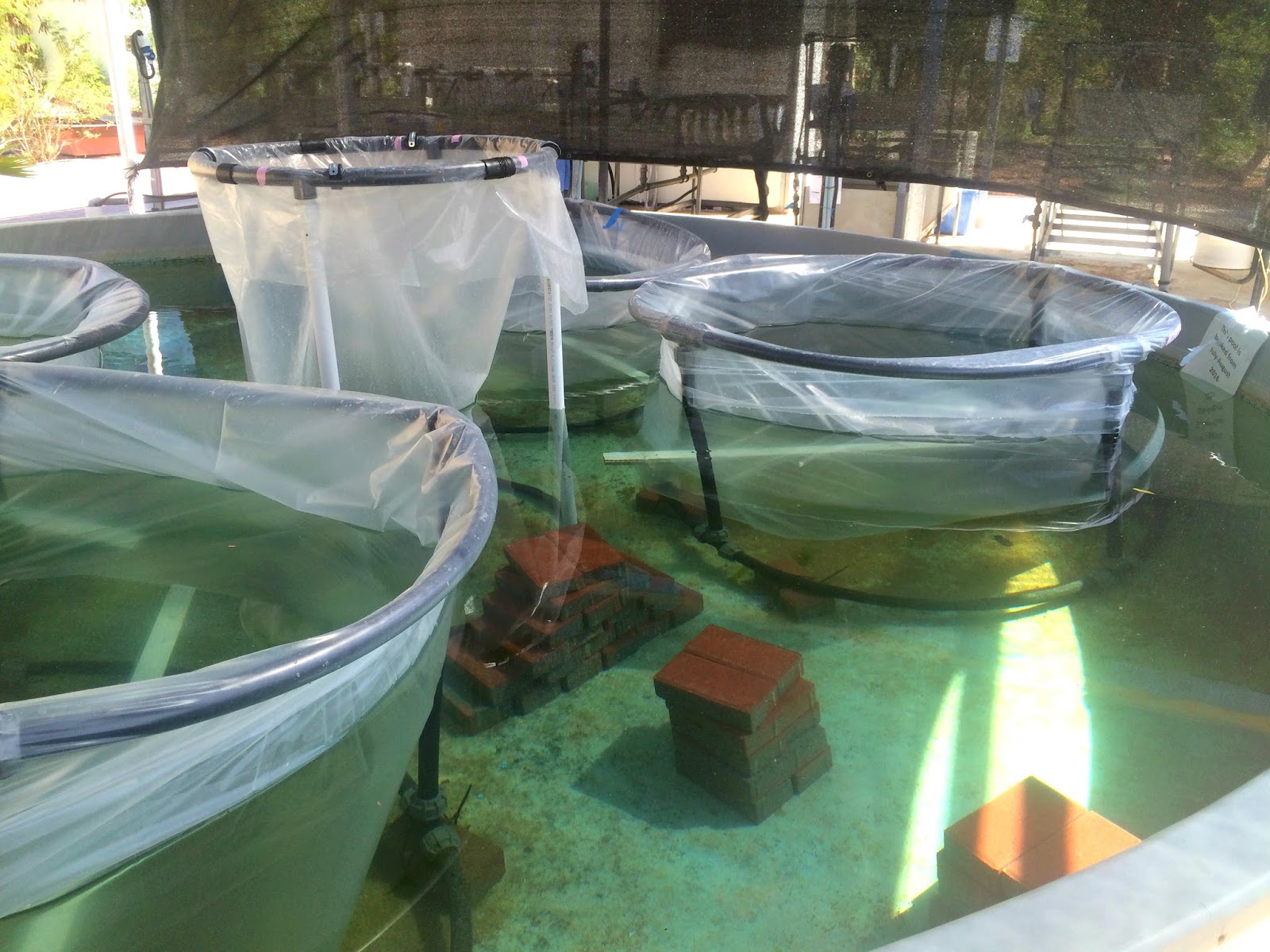

Mesocosms and miniature "towers" for improved access while sampling.


Sampling and counting zooplankton from each mesocosm every day allows me to monitor copepod concentrations over the course of the experiment. I pour a liter of mesocosm water through a filter through which copepods cannot pass, providing a sample which I then examine under a microscope. The number of copepods I count reflects their concentration per liter within the mesocosm.


A microscope photo of a filtered mesocosm sample, showing a copepod (right) and nauplius (left).


Panoramic view showing several experiments at IUI. The seawater tank holding the mesocosms is right next to the coral tanks where Karen works.


In a couple of days, we will dismantle the mesocosms and collect sediment samples from them. Here's to hoping that we find some fecal pellets!

The coral cliff hanger..

Working with biology is always funny. You can't really predict anything and as soon as things start to look good, life chooses another way and will mess everything up. It's the curse of biological experiments but also what makes it really fascinating and interesting to work with!

Something like that happened to my corals right after we added the different water treatments to the aquariums. After 24 hours in treated water, the coral fragments of species Acropora decided that life wasn't worth living anymore. Specially in one of the aquariums, they seemed to have planned a coordinated suicide demonstration. All of them were bleaching!


Bleaching event

A quick basic recap for those of you who might be unfamiliar with coral bleaching: Corals have a symbiotic relationship with a tiny little phytoplankton (Dinoflagellates) most commonly called zooxhantelleas. The zoox live in the coral tissue where they can photosynthesis giving the coral energy. In return the coral provides a safe refuge and essential nutrients. A nice win-win for both. However, if the coral is stressed it can expel the zoox - it will bleach! This can be fatal for the coral, but it is also possible for them to recruit new zoox and recover. 

 If this bleaching really was a result of our water treatment, that would be a very interesting and quick response! However, it seemed that only one aquarium was heavily affected.
To try to save the poor little things we moved them back to a control tank. Then added three new fragments in the affected aquariums and left them overnight to see if the same response would happen. We added more shade to the aquariums since the Acropora sp. can be very sensitive to light - maybe the combination of treated water and light was the problem?

Healthy Acropora.

Bleached Acropora

The next day the new test fragments looked fine. Our conclusion: the light intensity had been too high. I then spent the day chipping off new fragments to replace the bleached ones and got all the coral fragments back into the aquariums with the treated water.

They have now been there for a few days and the look to be surviving.
Experiment back on track !


Monday, July 11, 2016

Shellom!

T. maxima, right and T. squamosina, left

Snorkeling in the area around Eilat, I have been lucky to observe many live Tridacna of all three species I came to search for, and also many fossil specimens literally laying around on the ground. The live Tridacna include T. maxima (the most common), T. squamosa (less common), and T. squamosina (the rarest). 
The giant clams' reef environment
The reefs here are full of live hard coral and many juvenile clams, though large ones more than half a foot are harder to find. Yet my worries about not being able to find live specimens of T. squamosina appear to be without merit. I found specimens even directly offshore of heavily trafficked tourist beaches, which is encouraging as it means Tridcana is able to recruit and grow despite regular human disturbance. Though under threat, T. squamosina is holding on in the Eilat area. I intend to sample these live individuals with a syringe, which I can use as a standard to compare to the shell chemistry I see in the fossils.

A small, happy T. squamosa #happyasaclam

Walking up and down the road, I have found many likely fossil specimens of Tridacna laying in piles of excavated "reef rock" excavated during construction of IUI, the neighboring aquarium and the road itself. The reef rock is formed from the assorted rubble of the reef mixed with pebbles and cobbles of igneous rock sourced from on land.


Location of fossil site Tur Yam in comparison to IUI

This morning, I was able to chip out several specimens of T. maxima from a shelf of 5 thousand year old shelf of reef rock known as Tur Yam. These specimens will serve as the ancient baseline of Tridacna growth in the Eilat area before industrialization and population growth greatly increased human influence on the chemistry of the Red Sea.
A shell of T. maxima, in and out of the rock!


Sunday, July 10, 2016

Gulf of Eilat Plankton Tow

The water in the mesocosm experiments will require a much higher zooplankton concentration than that of ambient seawater. We need a to feed a lot of copepods in order to collect enough fecal pellets for analysis. So how do we acquire all these copepods? By catching them in a plankton net, of course!

Diagram of a plankton net.


Zooplankton are very small. To catch them, we deploy a piece of scientific equipment called a plankton net. Water can pass through the tiny holes in the plankton nets, but copepods do not. The net is towed behind the boat for an extended period (usually about ten minutes). After each tow, the contents of the collection bottle is transferred to a storage container. We do this around ten times to get enough zooplankton for the experiment.


Eyal preparing to drop the plankton net into the Gulf of Eilat for the first tow of the day.


Michele pulling the net back to the boat after it has towed underwater for ten minutes.


Eyal pulling the collection bottle out of the water after a tow while Emmanuel observes.


The results of one tow. Check out all those copepods!


It's pretty hot out on the boat, so we store the zooplankton in a cooler with ice to keep them happy before bringing them to shore. 


Stay tuned to see the next destination of these travelling copepods: the mesocosms!

Friday, July 8, 2016

Doing science : Cleaning aquariums !

It's almost been a week now in Eilat, and boy has it been busy!!

Dealing with jetlag and acclimating to the 40 *C desert was done by working 10-12 hours every day and half of that outside in the heat! For this poor Scandinavian that meant a whole lot of sweating!
But - much was accomplished this first week !

A few weeks back corals were collected for my experiment and was chipped in to fragments and put in tanks. All ready to be played with! However, no one had kept and eye on them since, so I arrived to every aquarium-enthusiast's worst nightmare:

 
Lovely coral-poop and algae infested tank
So the first day Noam and I spent on cleaning the tanks so the poor little corals could breathe again.
So to all of you who might think Science is this mystic and high-tech field - nah-a! Our tools for cleaning the tanks: credit cards, sponges and plastic tubes for sucking out water.

With 9 tanks to clean it took us several hours before they were shining again. But It was evident that the little poopers were happy again!

Before and after..
Happy little poopers

Now that the worst of the cleaning is done, only a daily short "vacuum" is needed to collect the coral poop. For yes, even Queens poop and therefor also corals! To minimize the algae growth their poop has to be sucked up everyday.

Coral poop


With all this aside I could start getting the experiment set up. Which means, setting up water pumps, creating brine, organizing sampling times, equipment etc. With help from Edo and Eyal, everything got prepped and done this Wednesday and Thursday at noon the experiment was official up and running! So now there are three tanks flowing with normal seawater, three flowing the higher salinity seawater and three with high salinity and specific chemicals.

Edo and Eyal setting up the water flow
Adina inspecting the 1000L water tank - always ready for a photo-op!
Our first samples were collected in the afternoon which meant a long night sampling. Sampling is both a fun and sad thing to do: The corals sampled will have to die, which I guess might disturb some people, but on the other side that means less corals to poop in the tank and less to clean up! The sampling involves removing the coral tissue from the skeleton (sounds much more dramatic than it is) by an airpump. And then purify the tissue into different sample vials that will later be analyzed.
With all the different corals and treatments I'm collecting 27 corals each sampling time. The sampling process is then a 6-7 hour long process with 5 people working non-stop. Luckily, I only have 3 sampling times.

Coral grave yard
Living Acropora sp.

This very morning, coming in to clean the tanks a lot of stuff had happened over night! The tanks with salt and chemicals had shown a major response to the treatment! Most of the corals were dead or dying! But that is a whole other story and I will leave that as a cliff hanger..
Stay tuned to learn about the fate of the little poopers !


Wednesday, July 6, 2016

Gulf of Eilat Sediment Trap Cruise

If you want to study zooplankton fecal pellets, you have to know where to find them. One great place to find large quantities of these tiny pellets is in marine sediment traps. A sediment trap is a scientific instrument used for measuring sinking particulate matter in aquatic systems. Collecting and analyzing sinking material helps oceanographers better understand a variety of physical and biogeochemical processes. 

I will be searching for fecal pellets in samples collected with a McLane sediment trap. 


Diagram of a McLane sediment trap.


With this trap design, sinking marine snow falls into a large underwater funnel. The material is collected in sample bottles at the bottom of the funnel which rotate every 1 or 2 days with a timed motor, to be replaced with a new bottle. This allows for separate samples in a time series, so that material fluxes may be studied across different time scales.

Today I had the opportunity to go on a short day cruise to retrieve moored sediment traps in the Gulf of Eilat.


The view of IUI from the Sam Rothberg RV vessel shortly after embarking.


We only had to travel a few kilometers offshore to retrieve traps deployed in water depths of over 700m. 


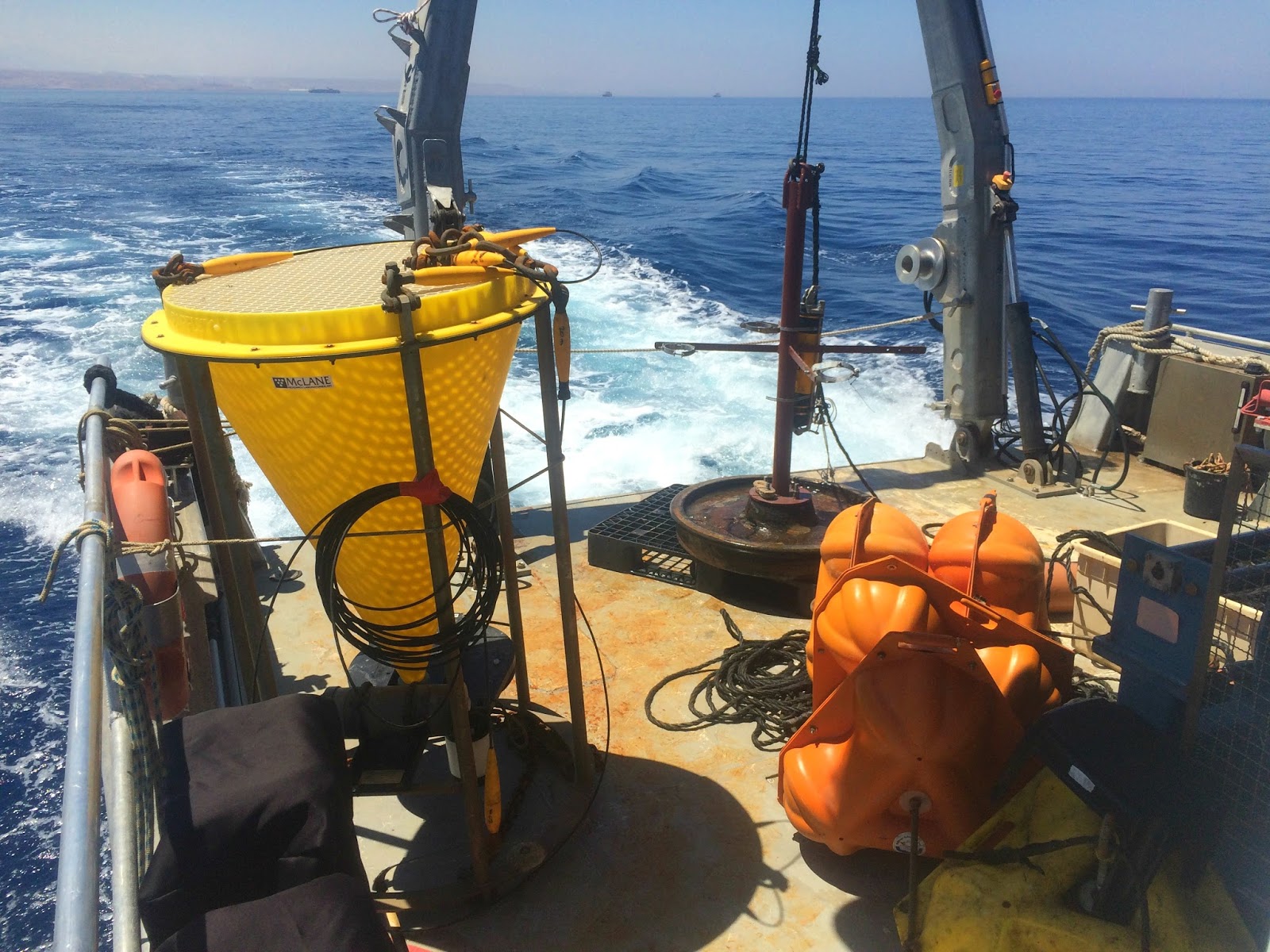
The marine crew recovering different sediment traps, as well as floats which
maintain the traps' depth during deployment and help locate them for retrieval.


The retrieved McLane trap in all of its glory, after sample bottles were removed for safe storage. 


Heading back to Eilat. Jordan's Port of Aqaba in the distance. 


Normally, all of the sample material collected from these sediment traps has been freeze dried for archives and various analyses. But for the first time ever, a fraction of the Gulf of Eilat time series samples have been preserved in their wet form with the help of some mercuric chloride. 


Preserved time series sediment trap samples, ready for 'scoping. Hope I can find some pellets in them!

Monday, July 4, 2016

We're here!


We have just finished our first full day at Interuniversity Institute in Eilat after driving down from Tel Aviv and stopping overnight for a stay in the Negev Desert at the Sde Boker satellite campus of Ben Gurion University. The campus is smack dab in the middle of the biblical desert and hosts institutes that study desertification, water science and other topics that demand immediate access to the extreme, beautiful environment of the Negev.

We toured the laboratories of the Zuckerberg Institute for Water Research, where Dr. Edo Bar-Zeev conducts research regarding the environmental impacts of desalination. Israel obtains much of its drinking water using desalination, and Edo is at the forefront of determining how this technology can be improved to maximum efficiency while maintaining minimum environmental impact.


Edo and our own Karen Petersen look at the reverse osmosis membranes used in desalination.

Edo also took us for breakfast at the edge of the vast canyon Ein Avdat, carved out by millions of years of erosion. It was an incredible vista, and we were joined by the local ibexes and mountain bikers. 

Afterwards we drove past Mitzpe Ramon and the massive nearby crater formed when a mountain was gradually eroded by riverine action. The topography and complex folding of underlying sediments were laid bare to see. 


After a short jaunt along the border, yesterday we arrived in the beautiful, hot and exotic environment of Eilat. Here on the Northern tip of the Red Sea we will conduct various experiments analyzing the health of coastal communities of the Gulf of Aqaba. Today was mostly consumed with meeting collaborators, getting permits, setting up experimental equipment, and other necessary work before we can get to the science! More updates soon as we continue our adventure.

View from the dive locker of IUI

Thursday, June 23, 2016

Project Synopsis: Particle impact on Ocean Omnivory and Processing (POOP)

A long-term goal of marine biogeochemical studies is to understand the processes involved in biological carbon sequestration in the ocean. Predicting the future course of atmospheric carbon dioxide (CO2) increases in response to anthropogenic emissions requires a complete understanding of all factors that govern the carbon cycle. A major sink of CO2 is the ocean “biological pump” – a term used to describe the transfer of carbon to the deep ocean for long term storage. Carbon is removed from the atmosphere via photosynthesis by phytoplankton, and ultimately ends up in the deep ocean as sinking organic matter. 

Some of the carbon-containing organic matter that sinks to the deep ocean is found in the fecal pellets of zooplankton, especially copepods. By most estimates, copepods are the most abundant animal on the planet by weight. They feed upon sharp and spiky phytoplankton, including glass-walled diatoms, so their fecal pellets have a strong membrane for a more comfortable exit. Compared to those of other organisms, copepod fecal pellets are fairly dense, hydrodynamic, and resistant to bacterial composition. Thus they sink to bottom of ocean faster, bringing plenty of carbon down with them.


I am investigating the impact of atmospheric dust deposition on the feeding and digestion processes of zooplankton, and its implications for the biological pump. 

It has been suggested that dust can increase the efficiency of the biological pump through various physical and chemical means. Dust is known to be a source of limiting nutrients and minerals to the ocean, and has shown to affect the responses of phytoplankton. However, we ultimately haven't been able to figure out the specifics of how this all works, and how to predict just how much carbon will sink.

So for my project, I am asking: what about the zooplankton, who eat the phytoplankton? How does dust deposition affect their digestion processes, and ultimately the amount of carbon sent to the ocean floor for long-term burial (via their poop)?

Our lab did some preliminary feeding experiments which yielded some very interesting results. Zooplankton were given different feeding solutions: some with only phytoplankton, and some had local dust mixed in as well. The zooplankton who ate the "dusty" solutions were eating a whole lot faster than those without dust... and they were producing more fecal pellets that had more carbon inside them.

It seems that dust particles act as "roughage" inside zooplankton guts: Food passes through them faster without being digested as efficiently. Reduced digestion means more of the carbon they consume remains trapped inside their fecal pellets, which will eventually sink to the deep ocean. On top of that, minerals in the dust make zooplankton fecal pellets bigger and denser, so they sink faster.

We are thinking that the presence of dust can result in the production of more fecal pellets, which sink faster, and contain greater amounts of carbon.... thus increasing the efficiency of the biological pump. 

Dust itself is sensitive to climate, so it's important that we understand this feedback mechanism. 


In the summertime, the Gulf of Aqaba is an oligotropic (nutrient-deplete) environment with a high dust input. Dust storms occur year round, with maximum inputs in late spring. This summer I will deploy sediment traps in the Gulf of Aqaba in time series and access archived samples from periods of variable dust deposition. I will also run zooplankton feeding experiments in seawater tanks at both the Gulf of Aqaba and the Mediterranean Sea. At IUI, I will collect and analyze zooplankton fecal pellets from both trap samples as well as the experiments.

Results will be compared with similar experiments conducted back in California, as well as data from fecal pellets collected from sediment trap archives across the world. Research will provide a wide range of results relevant to many disciplines. No quantitative or mechanistic understanding for these relations is currently available, and data documenting the process is limited. Investigation of this interaction will help improve our model of the ocean carbon cycle, and our understanding of carbon sequestration via the biological pump. 


Wednesday, June 22, 2016

Project Synopsis: The Ecological Effects of Desalination Brine


I wonder, how many of you reading this had ever considered drinking seawater? When I was a kid playing at the beach in summer times, my parents always told me not to drink the seawater; It would make me sick. In many parts of the world, ex. Denmark where I grew up, drinking water comes from the ground as groundwater, from rain, lakes, rives, aquifers or other terrestrial sources - not from the salty Ocean.
However, in other parts of the world, groundwater is extremely scarce and rain almost non-existing. How does people get drinking water in these regions? Well, one way is actually to drink the Ocean. Of cause not literally taking a glass down to the beach and pour in some water - but take the seawater and treat it; remove the salt; desalinate it.
The Ocean covers more than 70% of our globe and consists of almost 90% of all accessible water. Using this massive water resource for drinking water seems almost too logical.


Desalination of seawater is a widely used source of potable water in arid and semi-arid regions, like the Arabian Peninsula, Israel, parts of the Mediterranean region and now in drought-stricken California too.

The process of desalination can be described very simplified: Seawater is pumped into a desalination plants where, by various methods, the salt is removed and the water cleaned to make fresh drinking water. Many desalination plants are using reverse-osmosis to remove the salt from the water. In this method, pressure is applied to push the water through a semi-permeable membrane creating two products: fresh water and a high-salinity brine. The brine, along with various chemicals used for treatment and cleaning at the plant, is then discharge back into the ocean, very often in close proximity to shorelines and beaches.


Schematic diagram of the SWRO process


Despite the growing popularity of seawater reverse osmosis (SWRO) plants and the overall global interest in seawater desalination, very little is know about the consequences of discharging brine into coastal communities.

The addition of very saline water in a confined coastal area could cause changes in the biochemistry and biology potentially leading to changes in the trophic levels, coastal pollution or recreational disruption.


I study the effects of such brine in coastal areas. My main focus is the ecological effects on ocean organisms and I hope to be able to identify what happens in the coastal zone when discharging brine, which constituents in the brine is effecting organisms and the boundary limits and thereby help to increase the sustainability of seawater desalination.

During my time in Israel I will conduct two biological experiments, that hopefully will enlighten how different organisms will respond to brine discharge.

Phytoplankton growth

Firstly, I will look at how phytoplankton will respond in their growth, primary production and the structure of the community, eg. what species of phytoplankton is growing.
Phytoplankton make up the very bottom of the food chain, and changes in their growth and community could cause changes up through the higher trophic levels. Certain conditions can also favor certain phytoplankton species causing periodical blooms of plankton that can, depending on the species, be harmful for both fish, marine mammals and anthropogenic activities.
To test the effects of brine on phytoplankton, I will have to grow them under conditions I control and in a confined space I can access.
The method of choice is to add different treatments to bottles of seawater. The seawater will be collected directly from the ocean surface and will contain a random selection of the local phytoplankton community. The bottles containing seawater will then be treated different ways:

The first bottle will serve as control and have nothing added to the seawater. This bottle is the reference point. The second bottle will have added 1% brine, which will represent the lower margin of what can be assumed to be mixed in the coastal water. The third bottle will have 10% brine, which is representing a maximum concentration of brine. And a fourth bottle will contain some of the known chemicals and metals discharged along with the brine.
Over a period of 5 days the bottled and treated seawater will be monitored and by the end it will be possible to map out how the phytoplankton grew in the four different conditions.


Four bottles containing seawater and each a different treatment.


Coral health and growth

Secondly: I will be looking at coral health and growth in brine.
Corals are, to many, pristine ocean creatures and some of the most diverse and lively reefs are located in the Red Sea - many in close proximity to desalination discharge.
Coral reefs are crucial habitats, shelters and feeding grounds for enormous amounts of fish and seacreatues and are recreational havens for scuba divers and snorklers providing and important economic factor for the countries with coastal coral reefs.
The health and well-being of coral reefs are therefore important in many aspects.
In a similar manner as with the plankton, I will grow corals under specific conditions and monitor them. To do this, small fragments of corals has to be collected from the ocean. The fragments are collected from specific coral nurseries, that are artificial reefs in the ocean, where corals are grown with the specific purpose of using them in science experiments. This enables scientists to do research on corals without disturbing actual reefs.

For the corals a control and a 10% brine treatment will be monitored. Because of the much slower growth, this experiment will be running for a minimum of 4 weeks. Each week a coral fragment will be collected and it will be analyzed for its growth and for the growth of the symbiotic algae living within it.

Schematic of an aquarium with coral fragments growing in it


I am excited to get started on these experiments and see what will happen when, under controlled conditions, local species are introduced to a higher salinity.

Stay tuned the next two months for updates and pictures of the bottle incubations and aquariums full of corals!